What Is a Pun? Pun Meaning, Origin and How Wordplay Works 🎭

The pun meaning that dictionaries settle on is short: a joke that exploits a word with more than one sense, or two words that sound alike. What is a pun in practice, though, is something slightly more interesting than that definition suggests. It is a sentence that quietly holds two readings at once and lets you find the second one yourself.
That last part matters. Nobody laughs at a pun because the information is funny. They laugh because they caught it, and the catching happens in the space of about half a second.
Pun Meaning in Plain English
A pun takes one sound and hangs two meanings on it. “Seven days without a pun makes one weak” works because the ear cannot separate weak from week, and both readings make grammatical sense in that sentence. Break either condition and it stops being a pun. If only one reading works, it is just a sentence. If the second reading needs explaining, it is a failed one.
This is why puns are considered the most structural form of humour. A story joke can survive being retold badly. A pun cannot survive a single changed word.
Where the Word “Pun” Comes From
The word entered English in the mid-1600s, and its origin is genuinely uncertain. The most commonly cited theory traces it to the Italian puntiglio, meaning a fine or quibbling point, which travelled into English as punctilio before being clipped down to pun. It arrived as slang and was treated as low humour almost immediately, a reputation it has never fully shaken.
The device itself is far older than the word. Puns appear in ancient Egyptian texts, throughout the Hebrew Bible, in Greek drama, and constantly in Shakespeare, who reached for a play on words in comedies and tragedies alike. Mercutio, dying in Romeo and Juliet, says he will be a grave man tomorrow. That is a pun delivered at the worst possible moment, and it is deliberate.
How a Pun Actually Works
Every pun runs the same three-step sequence. First the sentence sets an expectation, so your brain commits to one meaning. Then a single word turns out to carry a second, equally valid sense. Then both readings sit in your head at once and refuse to resolve, and that unresolved collision is the laugh.
The pivot word almost always sits at the end. Move it to the middle and the joke deflates, because the listener finishes processing the double meaning while you are still talking. This is the most common reason a promising pun dies on delivery.
Pun, Play on Words and Double Meaning: What Is the Difference?
These three terms get used interchangeably, and they are not quite the same thing.
- Play on words is the broad category. Any deliberate manipulation of language for effect belongs here, including spoonerisms, anagrams and malapropisms.
- Pun is the specific device inside that category, one word carrying two senses simultaneously.
- Double meaning describes the effect rather than the technique. A pun always creates a double meaning, but a double meaning can also arise by accident, which is how most unfortunate newspaper headlines happen.
Put simply: every pun is a play on words, but not every play on words is a pun.
Homophone Puns (Sound-Alike Wordplay That Actually Works) 🔊

Homophone puns are the ones your ears fall for before your brain catches up. They use sound-alike words, two words that are spoken identically but carry completely different word meanings, and the joke lives in the gap between what you heard and what was meant. Say one out loud and it lands; write it down and half the magic leaks away.
This is the oldest trick in wordplay, and it is why so many language jokes stop working the moment you translate them. A pun built on “weak” and “week” has nowhere to go in a language where those two words sound nothing alike. English happens to be unusually rich in homophones, which is why it produces so many of these.
Classic Homophone Puns You Can Say Out Loud
- The knight could not sleep, and it made for a very long night.
- The baker stopped making bread because he kneaded a break.
- The sailor bought a boat and called the whole thing a great sail.
- The deer wrote a letter and opened it with “Deer Sir.”
- The bear simply could not bear the cold.
- The hare lost the race by a single hair.
- The monk only eats a sundae on a Sunday.
- The choir had no principle, but it did have a principal.
- The desert was completely deserted, which felt like just deserts.
- The stationery shop has stayed stationary for forty years.
- Those two ships have a genuinely excellent relationship.
- The forecaster told us to weather the weather, whatever the weather.
- The tailor quit because he was never really suited to it.
- The barber won the race because he knew a shortcut.
- The librarian was fully booked all afternoon.
- The clockmaker was arrested for killing time.
- The tree surgeon was completely stumped.
- The optician fell into the lens grinder and made a spectacle of himself.
- The archaeologist admitted her career was in ruins.
- A thief who stole a calendar got twelve months.
Food and Drink Homophone Puns
- The grape said nothing and simply let out a little wine.
- Lettuce turnip the beet before the neighbours complain.
- The loaf of bread just loafed around all afternoon.
- The cheese looked up and said it was gouda see you again.
- The coffee filed a police report because it got mugged.
- The tea was steeping in trouble again.
- Honestly, that soup was souper.
- The banana went to the doctor because it was not peeling well.
- The orange stopped mid-sentence because it ran out of juice.
- The mushroom gets invited everywhere because he is a fungi.
- The egg told a joke and the whole kitchen yolked.
- This pizza cutter is genuinely cutting-edge technology.
- The butter tried to escape but it was already on a roll.
- The pasta stopped and asked for a penne for your thoughts.
- The baker called his joke about flour a flower of speech.
Animal Homophone Puns
- The cat won the talent show because the routine was purr-fect.
- The dog sat in the shade so he would not become a hot dog.
- The cow’s favourite subject at school is moo-sic.
- The horse stayed calm because he is extremely stable.
- The owl was an absolute hoot at the party.
- The fish fell for it hook, line and sinker.
- The whale had, by all accounts, a whale of a time.
- The bee got married and it was a very buzzy wedding.
- The chicken crossed the road for a poultry reason.
- The frog parked illegally and got toad away.
- The sheep ended every message with wool talk soon.
- The duck paid its bill in full and left.
- The snake found the whole thing hiss-terical.
- The pig writes everything by hand in his pig-pen.
- The rabbit left early because he had somewhere to hop to.
Homophone Puns for Work and Everyday Life
- The electrician was genuinely shocked by the news.
- The plumber said the whole situation was draining.
- The mathematician would not stop because he was off on a tangent.
- The accountant stood up too fast and lost his balance.
- The photographer insists he was framed.
- The musician has far too many notes to pay.
- The teacher has a great deal of class.
- The dentist has serious pull around here.
- The nurse had patience with every one of her patients.
- The pilot’s career really did take off.
- The banker gave us his account of the story.
- The builder’s excuse simply did not hold up.
- The tailor’s story had a few loose threads.
- The carpenter’s presentation was riveting.
- The miner’s career hit rock bottom.
- The judge called it fair and square.
- The barista ground her way through the morning.
- The florist’s business really blossomed.
- The chef was under pressure, mostly from the cooker.
- The roofing joke went straight over your head.
Name and Place Homophone Puns
- Turkey is the only country you can eat at Christmas.
- Hungary is best visited on an empty stomach.
- Chile should really be served cold.
- Wales is a whale of a country.
- The reception in Iceland was a little frosty.
- I met a man from Cuba and we were Havana great time.
- Norway am I going back there.
- The trip to Poland turned out to be quite polarising.
- Paris in the spring is completely Seine-sational.
- My friend from Rome never gets lost, because all roads lead him home.
- My friend Bill always ends up getting the cheque.
- A man named Robin kept stealing from the rich.
- My friend Mark leaves his signature on absolutely everything.
- I know a woman called Faith and you simply have to believe her.
- A baker named Roland always rises to the occasion.
Homographic Puns (Spelled Identically, Mean Differently) 📝
Homographic puns use words spelled identically but with different pronunciations or meanings. Written form showcases these beauties best. Context determines which meaning you catch first.
- Atoms make up everything—literally and figuratively. ⚛️
- The calendar factory worker got fired; his days were numbered. 📆
- A chicken crossing the road is poultry in motion. 🐔
- The guy who survived pepper spray and mustard gas is a seasoned veteran. 🌶️
- I used to work at a shoe recycling plant—it was sole-destroying. 👞
- The short fortune teller who escaped prison was a small medium at large. 🔮
- Reading while sunbathing makes you well-red. ☀️
- The musician who played the tuba became known for his bass-ic skills. 🎺
- When the window fell on the gardener, it became a pane in his neck. 🪟
- The guy who invented knock-knock jokes got a no-bell prize. 🏆
- A dog gave birth on the sidewalk—she was cited for littering. 🐕
- Show me a piano falling down a mine shaft—I’ll show you A-flat minor. 🎹
- The magician got so mad he pulled his hare out. 🎩
- When fish are in schools, they take debate. 🐠
- A backwards poet writes inverse. ✍️
Compound Puns (Multiple Puns, Maximum Impact) 💥
Compound puns stack multiple puns into one glorious pun-chline. They’re wordplay on steroids. Two or three meanings collide simultaneously.
Why settle for one pun when you can have three? Compound puns layer meanings like a comedic lasagna. The lumberjack who’s “outstanding in his field” works on multiple levels—literally standing and professionally excellent.
- The lumberjack was outstanding in his field—literally standing among trees. 🌲
- The baker quit because he couldn’t make enough dough—and wasn’t on a roll. 🥖
- The scarecrow won an award—he was outstanding in his field. 🌾
- When the cannibal showed up late to dinner, they gave him the cold shoulder. 🥶
- The experienced fireman could always find the nearest exit—he knew all the ins and outs. 🔥
- The dentist and manicurist fought tooth and nail. 🦷
- A bicycle can’t stand on its own—it’s two-tired from the long journey. 🚴
- The chicken farmer’s business was growing—he was making eggs-ceptional progress. 🥚
- The grape stopped in the middle of the road because it ran out of juice and lost its drive. 🍇
- Santa’s helpers are subordinate clauses—they work under Santa’s clause. 🎅
- The vegetable comedian had the crowd in stitches—he was on a roll with his corny jokes. 🌽
- The electrician was shocked by his current situation—he couldn’t resist the opportunity. 🔌
- The tennis player was unhappy with his service—his game wasn’t going according to court. 🎾
- Becoming a vegetarian is a missed steak—you’ll never meat your potential. 🥩
- The Italian chef died—he pasta way, but left a pizza our hearts. 🍕
Literary Puns (Clever Wordplay in Classic Works) 📖
Literary puns are sophisticated wordplay woven into great writing. Shakespeare puns on “nothing” and “noting” constantly. Oscar Wilde crafted entire scenes around layered meaning.
Great writers use puns as literary devices to add depth. Romeo’s wordplay about his feelings creates both humor and tragic irony. That’s why studying Shakespeare means catching puns you missed in high school.
- Shakespeare’s Romeo says he’s “in choler” when he’s both angry and referring to bile. 😤
- Oscar Wilde’s entire play revolves around being “Earnest” versus being earnest. 🎭
- Lewis Carroll’s Mouse has a long tale—and tells a long tail-shaped story. 🐭
- In Hamlet, “country matters” is a risqué pun on anatomy. 👑
- Charles Dickens named a character “Mr. Gradgrind” to reflect his grinding personality. 📚
- Joyce’s Ulysses contains “lawn tennyson” instead of “Lord Tennyson.” ☘️
- Shakespeare’s “nothing” sounds like “noting” throughout Much Ado About Nothing. 💭
- Mark Twain wrote about “mourning” a loss while referencing morning time. 🌅
- Chaucer’s pilgrims go on both spiritual and literal journeys. 🚶
- Emily Dickinson writes about “Hope” as a thing with feathers—a bird. 🕊️
- Dr. Seuss created the Grinch whose heart “grew three sizes”—literally and emotionally. 💚
- Jane Austen’s “Pride and Prejudice” refers to character flaws and social attitudes. 👗
- George Orwell’s “Animal Farm” works as both farm story and political allegory. 🐷
- T.S. Eliot’s cats have both mundane and mystical names. 🐱
- Tolkien’s “Shire” evokes bothshire counties andshire horses. 🏞️
Simple Puns (Classic Dad Jokes Territory) 😄
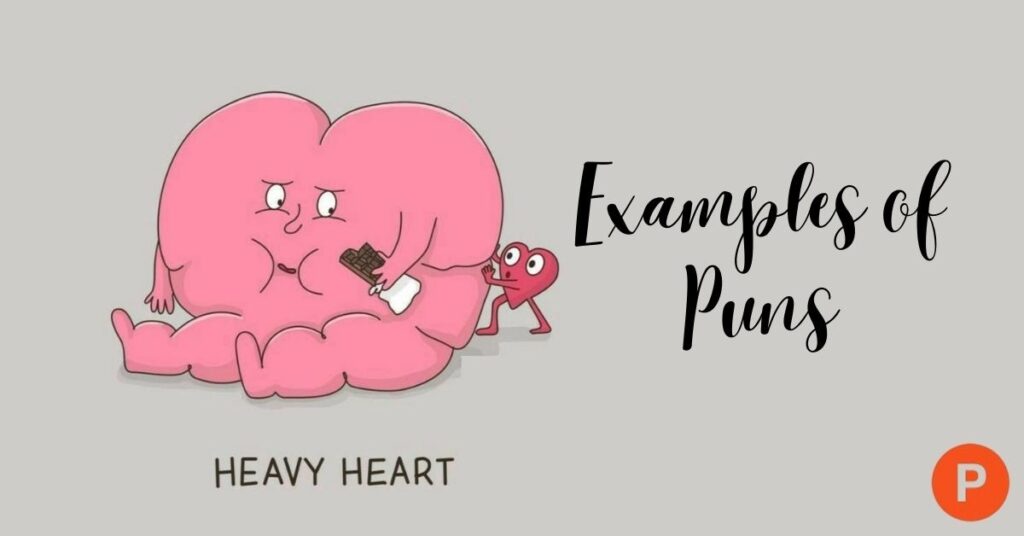
Simple puns are straightforward wordplay everyone gets immediately. Dad jokes live here. They’re the cross-eyed teacher who “couldn’t control his pupils” variety.
These are comedy comfort food. Simple puns don’t require deep thought—just a willingness to groan. The horror story written in Braille? “Something you could feel.” That’s it. That’s the joke.
- The cross-eyed teacher couldn’t control his pupils. 👀
- I wrote a horror story in Braille—it was something you could feel. 👻
- Russian dolls are so full of themselves. 🪆
- The cheese factory exploded—there was nothing left but de-brie. 🧀
- I couldn’t figure out why the baseball kept getting bigger—then it hit me. ⚾
- The guy who invented the door knocker got a no-bell prize. 🚪
- Parallel lines have so much in common—it’s a shame they’ll never meet. ➗
- I’m reading a book about anti-gravity—can’t put it down. 📕
- The shovel was a groundbreaking invention. ⛏️
- Velcro—what a rip-off! 🪡
- This is nacho cheese—it’s mine! 🌮
- I wondered why the frisbee was getting bigger—then it hit me. 🥏
- Atheism is a non-prophet organization. ⛪
- I used to be a banker—but I lost interest. 🏦
- The guy who fell into an upholstery machine is fully recovered. 🛋️
Everyday Conversation Puns 💬
Daily life brims with pun opportunities. Someone asks how you’re doing? “I’m grate—like cheese!” Casual conversations become comedy playgrounds.
Description 1: Wordplay puns in everyday situations keep interactions light. You’re not performing stand-up; you’re just making someone smile during their lunch break. That’s the magic of conversational puns.
Description 2: These puns emerge organically from real-life contexts. Talking about the weather? “It’s rain-ing cats and dogs—I just stepped in a poodle!” Natural. Easy. Effective.
- When someone asks if you’re cold: “I’m chili—get it?” 🌶️
- At the bakery: “I’m on a roll today!” 🥐
- After a workout: “That was exhausting—I’m totally drained!” 💦
- Discussing plans: “Sounds grape to me!” 🍇
- When running late: “Sorry, I’m behind schedule—literally!” ⏰
- About a difficult task: “This is really testing my patients—oh wait, patience!” 🏥
- When leaving: “I’m headed out—lettuce go!” 🥬
- During coffee break: “This is brew-tiful!” ☕
- About the weather: “It’s so hot, I’m melting—what a meltdown!” ☀️
- When someone trips: “I’m falling for you!” 💕
- At the gym: “Working out is a real pain—literally!” 🏋️
- About Monday: “Case of the Mondays? More like case closed!” 📁
- When hungry: “I’m starving—send provisions or a pro-vision!” 🍔
- About being tired: “I’m exhausted—running on empty!” ⛽
- When excited: “I’m pumped—like a bicycle tire!” 🚲
Food Puns (Berry Good Humor) 🍓
Food puns are comedy gold. “You’re the apple of my eye” works because everyone loves food references. They’re relatable, visual, and delicious.
Description 1: Humorous food wordplay dominates social media. “Lettuce celebrate!” “You’re one in a melon!” These phrases stick because they combine universal experiences with clever twists.
Description 2: Restaurants use food puns in advertising constantly. “Nacho average restaurant!” works because it’s memorable. The cheese reference plus the sound-alike “not your” creates instant brand personality.
- You’re the apple of my eye! 🍎
- Lettuce celebrate this achievement! 🥬
- You’re one in a melon—truly special! 🍉
- Life is gouda when you’re around! 🧀
- Olive you so much! 🫒
- You’re bacon me crazy! 🥓
- I’m soy into you! 🥡
- Orange you glad we met? 🍊
- You’re tea-riffic! 🍵
- Donut worry, be happy! 🍩
- That’s the way the cookie crumbles! 🍪
- You’re the cream of the crop! 🥛
- Stop being so cheesey! 🧀
- I’m nuts about you! 🥜
- This is un-beer-lievable! 🍺
Animal Puns (Paws-itively Hilarious) 🐾
Funny animal puns dominate internet humor. “What’s up, dawg?” “Turtle-y awesome!” Animals provide endless wordplay material because we anthropomorphize them constantly.
Description 1: Animal wordplay connects with pet owners especially. “Paws and reflect” makes dog lovers smile. “Ewe are the best” works for sheep enthusiasts. Niche audiences love targeted animal humor.
Description 2: Kids adore animal puns. “What did the duck say when he bought lipstick? Put it on my bill!” Simple. Visual. Memorable. That’s why children’s books overflow with animal wordplay.
- I’m paws-itively excited! 🐕
- That’s turtle-y awesome! 🐢
- Ewe are the best! 🐑
- You’re the koala-ty friend I needed! 🐨
- This is otter-ly ridiculous! 🦦
- I’m not lion when I say you’re great! 🦁
- You’re panda-monium in the best way! 🐼
- Stop being so crabby! 🦀
- You’re one cool cat! 😺
- Whale, hello there! 🐋
- Alpaca my bags—I’m ready! 🦙
- You’re irrelephant—wait, I mean irrelevant! 🐘
- I’m raven about this! 🐦⬛
- You’re very im-peck-able! 🐔
- This is hawk-ward! 🦅
Puns in Entertainment (Movie & TV Magic) 🎬
Famous movie pun examples include “Frozen” with “Let it go—let it snow.” TV shows like “The Office” thrive on Michael Scott’s cringey wordplay. Entertainment media loves puns.
Sitcoms particularly excel at pun-based humor. “Friends” had Joey’s “How you doin’?” which played on multiple meanings. “Brooklyn Nine-Nine” features constant detective-themed wordplay. It’s formulaic but effective.
- Austin Powers: “Yeah, baby, yeah!”—playing on enthusiasm and babies. 👶
- The Simpsons: “Don’t have a cow, man!”—literally and figuratively. 🐮
- Arrested Development: “There’s always money in the banana stand!” 🍌
- Parks and Rec: “Treat yo self!”—sounds like “treat yourself.” 🎁
- Shrek: “Ogre-whelming odds.” 👹
- Frozen: The entire kingdom is “frozen” emotionally and literally. ❄️
- Toy Story: “To infinity and beyond!”—space pun on limits. 🚀
- Monsters Inc.: “Harryhausen’s” restaurant reference. 👾
- The Simpsons: “Sneed’s Feed & Seed (Formerly Chuck’s).” 🌾
- BoJack Horseman: Character names like “Princess Carolyn” (feline royalty). 🐱
- Futurama: “Amazon” becomes “Amazonians”—a warrior race of women. 👸
- The Good Place: “Holy forking shirtballs!”—censored swearing. 😇
- Spongebob: “The Krusty Krab” versus “crusty crab.” 🦀
- Adventure Time: “Mathematical!”—instead of “radical.” 🧮
- Rick and Morty: Dimension “C-137″—sounds like “see one thirty-seven.” 🛸
Puns in Literature (Written Wordplay Mastery) 📚
Popular literature pun examples showcase authorial brilliance. Mark Twain’s work overflows with Mississippi River-related wordplay. These aren’t accidents—they’re deliberate literary devices.
Classic authors understood that puns add texture. Oscar Wilde’s “The Importance of Being Earnest” literally revolves around a name pun. The entire plot hinges on “Ernest” versus “earnest.” That’s commitment.
- Oscar Wilde: “The Importance of Being Earnest”—earnest versus Ernest. 💼
- Dr. Seuss: “Hop on Pop”—literal and figurative hopping. 👨
- Lewis Carroll: “A-lice” sounds like “all ice” in winter wonderland. ❄️
- Charles Dickens: “Oliver Twist”—both a name and plot descriptor. 🎩
- J.K. Rowling: “Diagon Alley” sounds like “diagonally.” 🧙
- Shakespeare: “Much Ado About Nothing”—nothing/noting wordplay. 🎭
- Mark Twain: “The Adventures of Tom Sawyer”—sawing adventures. 🪵
- Roald Dahl: “Willy Wonka”—wonky willy. 🍫
- Terry Pratchett: “Mort” (death’s apprentice)—means death in French. ⚰️
- Douglas Adams: “Arthur Dent”—a dent in the universe. 🌌
- P.G. Wodehouse: Character “Gussie Fink-Nottle”—fishy personality. 🐟
- Jane Austen: “Sense and Sensibility”—sounds alike, means different. 💭
- Lemony Snicket: “A Series of Unfortunate Events”—unfortunate series. 📖
- Neil Gaiman: “Neverwhere”—never there, nowhere. 🚇
- Tom Robbins: “Jitterbug Perfume”—bugs that jitter. 🪲
Puns in Advertising (Catchy Commercial Wordplay) 📺
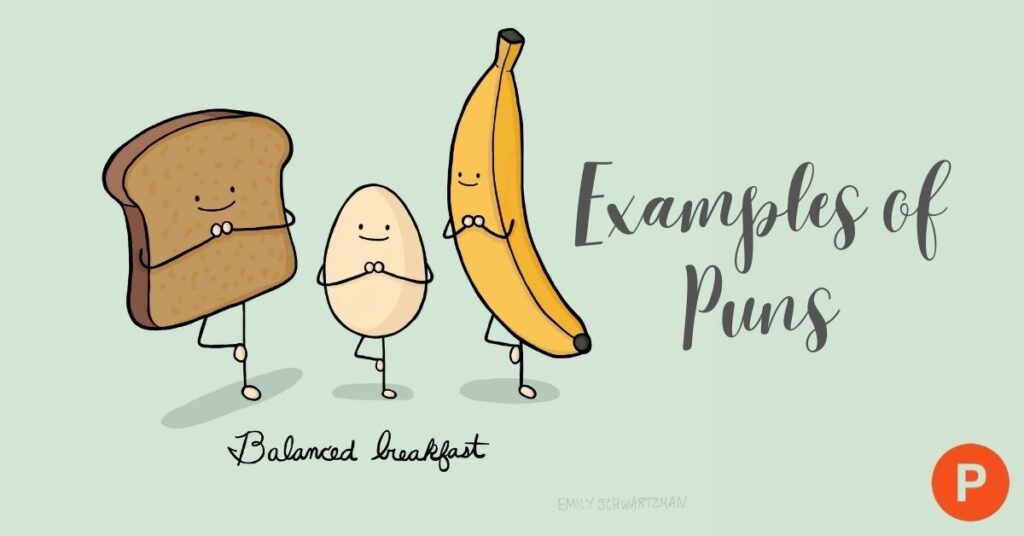
Puns in headlines grab attention instantly. “Orange you glad you tried our juice?” works because it’s memorable. Advertising copywriters know puns sell.
Description 1: Print ads historically loved puns. A 1960s Volkswagen ad stated “Think Small”—playing on both car size and revolutionary thinking. Simple. Effective. Iconic.
Description 2: Billboard advertising thrives on quick wordplay. “Eye drops off ledge, creates jam” (for traffic safety) uses shocking imagery plus a pun. That double-take makes people remember.
- Optical store: “See what you’ve been missing!” 👓
- Gym advertisement: “No pain, no gain—join today!” 💪
- Bakery billboard: “You knead this bread!” 🍞
- Coffee shop: “Espresso yourself!” ☕
- Bookstore: “So many books, so little thyme!” 📚
- Dentist office: “We’ll do fillings for you!” 🦷
- Hair salon: “We’ll make the cut!” ✂️
- Pet store: “A purr-fect place!” 🐱
- Florist: “We’re blooming with excitement!” 🌸
- Pizza place: “A pizza my heart!” 🍕
- Shoe store: “We’re a perfect fit!” 👟
- Dry cleaners: “We’ll press your luck!” 👔
- Auto shop: “We brake for no one!” 🚗
- Garden center: “We’re rooting for you!” 🌱
- Seafood restaurant: “Holy mackerel, that’s good!” 🐟
Cultural Significance of Puns 🌍
Puns hold massive cultural significance across societies. Ancient Egyptians carved hieroglyphic puns. Romans loved wordplay. This isn’t modern invention—it’s human nature.
Description 1: Pop culture shapes through puns constantly. Memes like “When life gives you lemons” spawn countless variations. Each culture adapts wordplay to local language quirks, creating unique comedic signatures.
Description 2: Puns reflect linguistic sophistication. Bilingual puns especially showcase cultural bridging. Spanish speakers mixing English and Spanish create “Spanglish” puns that work in both languages simultaneously.
- Ancient Egyptians used pictorial puns in hieroglyphics. 𓀀
- Shakespeare elevated puns to high art in theater. 🎭
- Victorian England hosted pun competitions in newspapers. 📰
- Jazz Age America featured pun-filled vaudeville acts. 🎩
- 1960s counterculture used puns for social commentary. ✌️
- Advertising’s golden age weaponized wordplay commercially. 📺
- Internet memes revived pun culture for millennials. 💻
- Dad jokes became a celebrated pun subgenre. 👨
- Rap music incorporates complex multilayered puns. 🎤
- Stand-up comedy relies heavily on pun-based humor. 🎙️
- Children’s literature uses puns for language development. 📚
- Political cartoons employ puns for satirical edge. 🗞️
- Restaurant names globally feature food puns. 🍽️
- Social media hashtags create instant pun trends. 📱
- Greeting cards build entire industries on pun humor. 💌
Why People Love Puns ❤️
Humans crave wordplay because it makes language fun. Puns create “aha moments” that light up our brains. That cognitive reward feels good.
Description 1: Puns serve as communication tools beyond just humor. They demonstrate intelligence, build rapport, and show cultural literacy. Sharing a pun creates instant social bonding.
Description 2: The groan factor doesn’t diminish pun appeal—it enhances it. That exaggerated eye-roll? It’s actually an acknowledgment of cleverness. People secretly appreciate the mental gymnastics.
- Puns make language playful and engaging. 🎪
- They create memorable moments in conversations. 💭
- Wordplay demonstrates quick thinking and creativity. 🧠
- Puns build social connections through shared laughter. 🤝
- They’re accessible across age groups and cultures. 🌐
- Puns provide harmless, clean humor for all. ✨
- They showcase linguistic knowledge and skill. 📖
- Wordplay adds personality to communication. 🎭
- Puns create “aha moments” that feel rewarding. 💡
- They’re versatile across written and spoken forms. 🗣️
- Puns make advertising more memorable and effective. 📢
- They help children develop language skills naturally. 👶
- Wordplay offers creative expression through constraints. 🎨
- Puns lighten serious situations appropriately. 😊
- They’re free entertainment anyone can create. 🎁
Tips for Creating Your Own Puns ✍️
Crafting puns requires practice but anyone can learn. Start with homophones—words sounding identical. “Write” and “right” offer endless possibilities.
Description 1: Listen for double meanings everywhere. Conversations, songs, books—potential puns hide in plain sight. Keep a notes app handy for capturing inspiration. Your first hundred attempts might bomb, but persist.
Description 2: Study masters like Stewart Francis or Tim Vine. Notice how they set up expectations then twist them. The structure matters: establish context, introduce the wordplay, land the punchline. Timing elevates mediocre puns to great ones.
- Listen actively for words with multiple meanings daily. 👂
- Keep a pun journal—write down all wordplay ideas. 📓
- Read extensively to expand vocabulary options. 📚
- Study successful puns to understand structure patterns. 🔍
- Practice timing—delivery makes or breaks puns. ⏱️
- Don’t force it—let puns emerge naturally from context. 🌊
- Test puns on friends before public deployment. 👥
- Learn homophones, homographs, and linguistic quirks deliberately. 📖
- Watch pun masters perform and analyze techniques. 🎬
- Join online pun communities for feedback and inspiration. 💬
- Accept that some puns will flop—keep trying anyway. 🎯
- Build setup-punchline structures consciously in writing. 🏗️
- Use unexpected contexts to make old puns fresh. 🔄
- Combine multiple pun types for compound effects. 🎪
- Remember: confidence sells even mediocre puns effectively! 😎
Frequently Asked Questions About Puns ❓
What is the simplest pun meaning?
A pun is a joke built on a word that carries two meanings at once, or on two words that sound the same. The humour comes from both readings being true at the same moment.
What are homophone puns?
Homophone puns use sound-alike words, two words spoken identically but spelled differently and meaning different things, such as weak and week or bear and bare. They are the most common type of pun in English and they work best spoken aloud.
What is the difference between homophone puns and homograph puns?
Homophone puns rely on words that sound the same but are spelled differently. Homograph puns rely on one spelling with two separate word meanings, such as bark on a tree and the bark of a dog. Homophones work best out loud; homographs read better on the page.
Are puns a sign of intelligence?
Spotting a pun requires holding two meanings of a word in mind at the same time and switching between them quickly, which is a genuine language-processing skill. Whether that counts as intelligence is a matter of opinion, and the opinion usually depends on whether you made the pun or heard it.
Why do people groan at puns?
The groan is recognition, not rejection. It signals that the listener understood the second meaning but felt the joke arrived too easily. A groan is closer to applause than most punsters are given credit for.
Who invented puns?
Nobody. Puns predate written records of humour entirely and appear independently in ancient Egyptian, Hebrew, Greek, Latin and Chinese texts. Any language with words that sound alike will produce them on its own.
Also read this article: 200+ Valentine’s Day Puns That’ll Make Your Heart Skip a Beat

Well Smith is the brain behind Puns Pop, serving fresh wordplay and clever puns daily. With a sharp sense of humor and a love for laughter, he turns everyday moments into punchlines. From food jokes to work humor, Well brings a witty twist to life, one pun at a time.